
I Left Pharmacy to Open a Barbershop in Lekki, and My First Client Was Nine Years Old
A pharmacist trades her white coat for clippers, and learns that a good cut is mostly about patience.
Choose your narrator
In short
Start small. Cut hair on weekends, take a short barbering course, and open with two chairs. Treat every haircut as an act of trust, and keep in mind the client whose reaction reminds you why you do the work.
- Desk:
- lifestyle
- Format:
- article
- Author:
- Eniola Unfilltered
I should say at the start that I did not plan to become a barber. I planned to be a pharmacist, and for six years I was a very good one.
I qualified in Ibadan, worked my way up to a branch manager’s position at a big chain pharmacy in Lekki, and spent my days counting tablets and explaining dosages to anxious people. It was a respectable job. My mother told every relative she met that her daughter was “a doctor of medicine, basically.”
Then, one Saturday morning, my nephew came home from a bad haircut.
The haircut
My nephew Kayode was nine years old, a serious boy with large eyes and a habit of folding his arms when he was upset. He walked into my sitting room that Saturday with a patch missing from the side of his head, like a lawn that had been mowed by someone in a hurry.
“Aunty,” he said, “the barber said it was a fade.”
It was not a fade. It was a mistake. A small, quiet, humiliating mistake that a nine year old would carry into school on Monday morning.
I did what any reasonable person would do. I called three barbers. Two did not pick up. The third said, “Madam, I am closed on Saturdays.”
So I took out the clippers I had bought on a whim a month earlier, after watching a long video about fade techniques late one night when I could not sleep. I sat Kayode on a stool in the kitchen, put a towel around his shoulders, and tried to repair the damage.
It took ninety minutes. I made it worse twice. At one point he whispered, “Aunty, are you sure you know what you are doing?” and I said, “Nobody has ever been surer.” We both laughed. By the end he had a clean, even cut that looked intentional.
He looked at himself in the bathroom mirror for a long time. Then he turned to me with a face I will remember for the rest of my life, and said, “Aunty, I look like myself again.”
The decision
I could not stop thinking about those words.
For six years I had helped people feel better by handing them a small white bag of tablets. In ninety minutes, with a pair of clippers and a kitchen stool, I had made a nine year old boy feel like himself. It was a different kind of medicine, and I wanted more of it.
I started cutting hair on weekends. First my brothers, then my neighbours, then a friend’s husband who said he could not trust anyone else after a bad experience. I enrolled in a six week barbering course in Surulere, the only woman in a room of twenty two men, and I spent a month learning the names of tools I had never seen. Guards, tapers, shears, a straight razor that I held, at first, as if it might bite.
After eight months, I resigned from the pharmacy. My mother did not speak to me for four days.
The shop
I opened my barbershop in a small unit off a quiet road in Lekki, with two chairs, a mirror that took me three weeks to hang straight, and a hand painted sign that my cousin did for free. I called it Steady Hands. It was the compliment my old supervisor used to give me when I counted out tablets, and it seemed the right name.
The first month, nobody came. I sat in the empty shop sweeping the same floor, rearranging the same combs, wondering if my mother had been right.
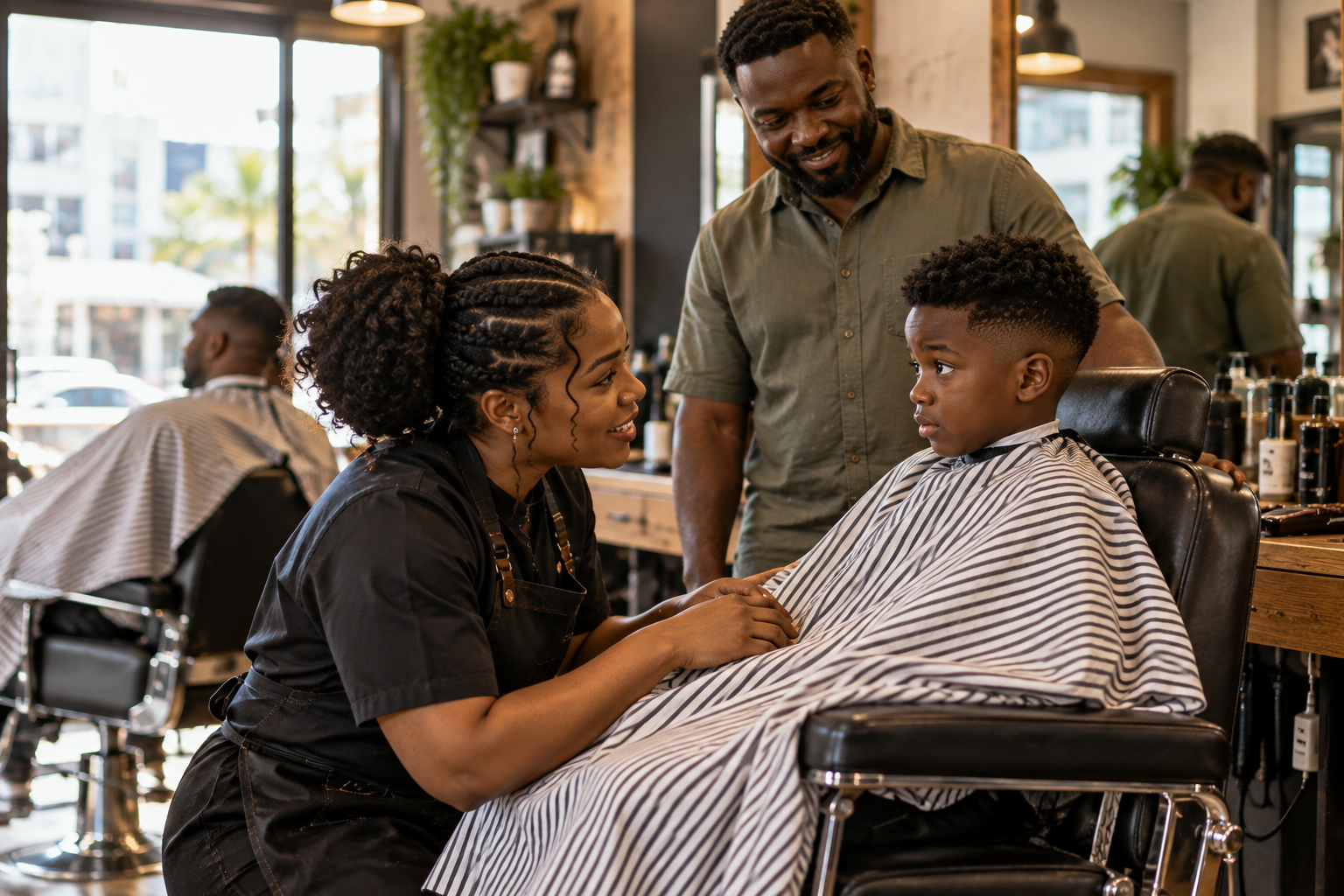
The first customer was a boy. He was nine years old, about the age of my nephew, and he arrived holding his father’s hand. His father said, quietly, “He is very nervous. His last barber shouted at him.”
I knelt in front of the boy and said, “My name is Aunty Bisi, and I have a rule. If you want me to stop, you only need to lift your hand. I will stop immediately. No questions.”
He studied me for a long moment, serious and skeptical. Then he climbed into the chair.
I cut slowly. I talked to him about football, about school, about his favourite biscuit. When the clippers came near his ear, I paused and asked, “Is this okay?” and he nodded. At the end, he looked in the mirror, touched the side of his head, and smiled with half his mouth, the way a boy smiles when he does not want to look too pleased.
The next week, his father came back with his two brothers.
What the shop taught me
I have learned more about people in the barber’s chair than I ever did behind a pharmacy counter. A haircut is an act of trust. Someone sits still, in front of a mirror, while you stand behind them holding something sharp. They are vulnerable, whether they admit it or not.
Men talk differently in a barber’s chair. They tell you about job losses, about weddings they are dreading, about a father they have not forgiven. I have learned to listen without comment and to clean the clippers slowly when the conversation turns heavy. A good barber knows when to speak and when to buzz quietly.
I also learned that grooming is more than vanity. A man with a sharp cut walks into an interview straighter. A boy with a clean fade walks into school with his head up. A good cut changes how people carry themselves, and that change goes with them for days.
If you are thinking about leaving a job you are good at for one you love, I will tell you what I tell my apprentices. Start small. Cut on weekends. Learn the tools. Find your Kayode, the person whose face changes when you do your work properly, and keep that face in mind on the days you doubt yourself.
Last month, Kayode, who is now twelve, swept the floor of my shop for pocket money. He stopped by my chair and watched me finish a taper fade. “Aunty,” he said, “when I am older, can I have a chair here?”
“You can have two,” I said.
My mother still calls me a doctor of medicine, basically. I have stopped correcting her.
- Beauty
- Grooming
- Hairstyle
- Lekki
- Barbershop
Tip: highlight any line in the story to turn that line into a share card.
Frequently asked
- What is “I Left Pharmacy to Open a Barbershop in Lekki, and My First Client Was Nine Years Old” about?
- A pharmacist trades her white coat for clippers, and learns that a good cut is mostly about patience. I should say at the start that I did not plan to become a barber.
- Who covers lifestyle on PINCHED?
- Eniola Unfilltered reports this piece for the PINCHED lifestyle desk.
- Where can I read “I Left Pharmacy to Open a Barbershop in Lekki, and My First Client Was Nine Years Old”?
- Read it in full at https://staypinched.site/read/leaving-pharmacy-to-open-a-barbershop-in-lekki.