
Cascador and Sterling Bank Launch a $200 Million Credit Backstop to Help Nigerian SMEs Get Larger, Longer Loans
The fund shares lending risk with banks so that businesses with real customers and revenue, but little collateral, can borrow more. It could support up to $1 billion in outstanding credit, though that is a target and not money available today.
Choose your narrator

In short
Cascador and Sterling Bank launched a $200 million SME Credit Backstop Fund that shares lending risk with banks so Nigerian SMEs can get larger, longer-term loans, with initial loans of about $250,000.
- Desk:
- tech
- Format:
- article
- Author:
- Kenneth Onyebuchi
Cascador and Sterling Bank have launched a $200 million SME Credit Backstop Fund meant to help Nigerian small and medium businesses get larger, longer-term loans, as BusinessDay's coverage of the launch sets out. The fund shares credit risk with lenders, and Cascador says the model could support up to $1 billion in outstanding credit as it grows.
How the Backstop Works
Cascador acts as nominator and guarantor, and Sterling Bank acts as lender. Venture funds and business studios that know a company recommend it as a borrower. The fund then applies its own eligibility, guarantee and portfolio-risk standards, using AI-powered underwriting and due diligence, and participating banks assess, approve and disburse the loans themselves.
The backstop does not approve loans automatically. Banks decide who qualifies under their own criteria, and the fund's protection applies within the terms of its guarantee.
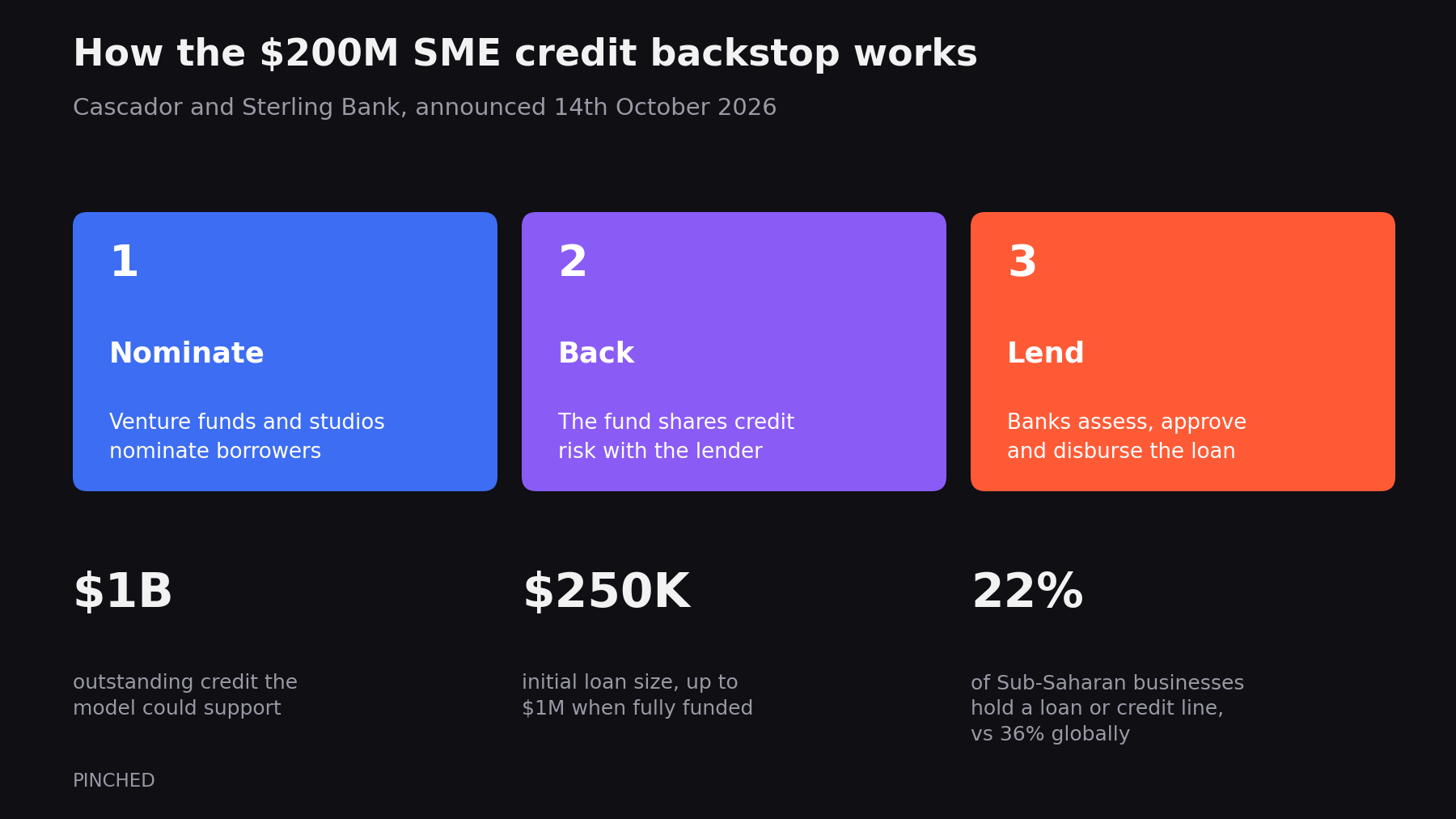
The backstop model announced by Cascador and Sterling Bank
Loan Sizes and Who Pays In
Initial local-currency loans are expected to be equivalent to $250,000, subject to lender approval, rising to as much as $1 million per loan when the fund is fully funded, as TechAfrica News lays out. The facility builds on a catalytic fund that Cascador and Sterling piloted for about two years. It is designed to take in other capital from philanthropic organisations, impact investors and development finance institutions.
The fund operates through Riverwell Platform Holding Limited and Riverwell Platform Services Nigeria, with reserve capital held and managed separately.
The Gap It Is Aimed At
Only 22% of businesses in Sub-Saharan Africa have a bank loan or credit line, compared with 36% globally, a figure from Cascador's white paper The Multiplier Model that BusinessDay cites. Many SMEs with customers and revenue still struggle to borrow because lenders often ask for collateral and guarantees that do not fit how those businesses operate.
Cascador's portfolio includes 80 ventures that have raised more than $150 million since 2019. That track record matters because the model leans on trusted nominators, and not on collateral, to identify borrowers.
What They Said
Trish Thomas, CEO of Cascador, said the fund aims to "create a practical route to debt for Nigerian businesses with proven traction", as ThisDay quoted her. Obinna Ukachukwu, a group executive at Sterling Bank, said the arrangement gives the bank "greater confidence to provide larger, longer-term loans."
What Is Still Unknown
The $1 billion figure is a capacity target, and lending volume depends on how fully the fund is capitalised and on whether banks are willing to lend to eligible businesses. The announcement does not give a timeline for full funding or the number of loans expected.
It also lands at a time when equity funding has been uneven. Nigerian startups raised $11.3 million across nine deals in September, well below August, which makes debt routes like this one more relevant for founders.
Frequently Asked Questions
What Is the Cascador and Sterling Bank SME Credit Backstop Fund?
It is a $200 million fund that shares credit risk with lenders so that Nigerian SMEs can access larger, longer-term loans. It could support up to $1 billion in outstanding credit.
How Large Are the Loans?
Initial local-currency loans are expected to be equivalent to $250,000, subject to lender approval, and up to $1 million per loan once the fund is fully funded.
Who Decides Which Businesses Get Loans?
Venture funds and studios nominate borrowers, but participating banks assess, approve and disburse the loans under their own criteria.
Is the $1 Billion Available Now?
No. It is the credit capacity the model could support as the fund grows, not money already available to SMEs.
- Cascador
- Sterling Bank
- SME financing
- credit guarantee
- Nigeria startups
- venture debt
- Riverwell
- collateral
Tip: highlight any line in the story to turn that line into a share card.
Frequently asked
- What is “Cascador and Sterling Bank Launch a $200 Million Credit Backstop to Help Nigerian SMEs Get Larger, Longer Loans” about?
- The fund shares lending risk with banks so that businesses with real customers and revenue, but little collateral, can borrow more. It could support up to $1 billion in outstanding credit, though that is a target and… The fund shares lending risk with banks so that businesses with real customers…
- Who covers tech on PINCHED?
- Kenneth Onyebuchi reports this piece for the PINCHED tech desk.
- Where can I read “Cascador and Sterling Bank Launch a $200 Million Credit Backstop to Help Nigerian SMEs Get Larger, Longer Loans”?
- Read it in full at https://staypinched.site/read/cascador-sterling-bank-200-million-sme-credit-backstop.