"They Don't Give Us Enough Accolades": Location Sound Recordist Olamilekan Lasisi Murphy
Murphy has recorded sound next to a generator nobody could switch off, watched a finished film get rejected by a streaming platform over bad audio, and still can't tell you a single colleague who owns a complete professional kit. He talks to PINCHED about the department that stands alone on every Nigerian set, and why directors keep learning the hard way that they should have listened to their sound man.
Choose your narrator
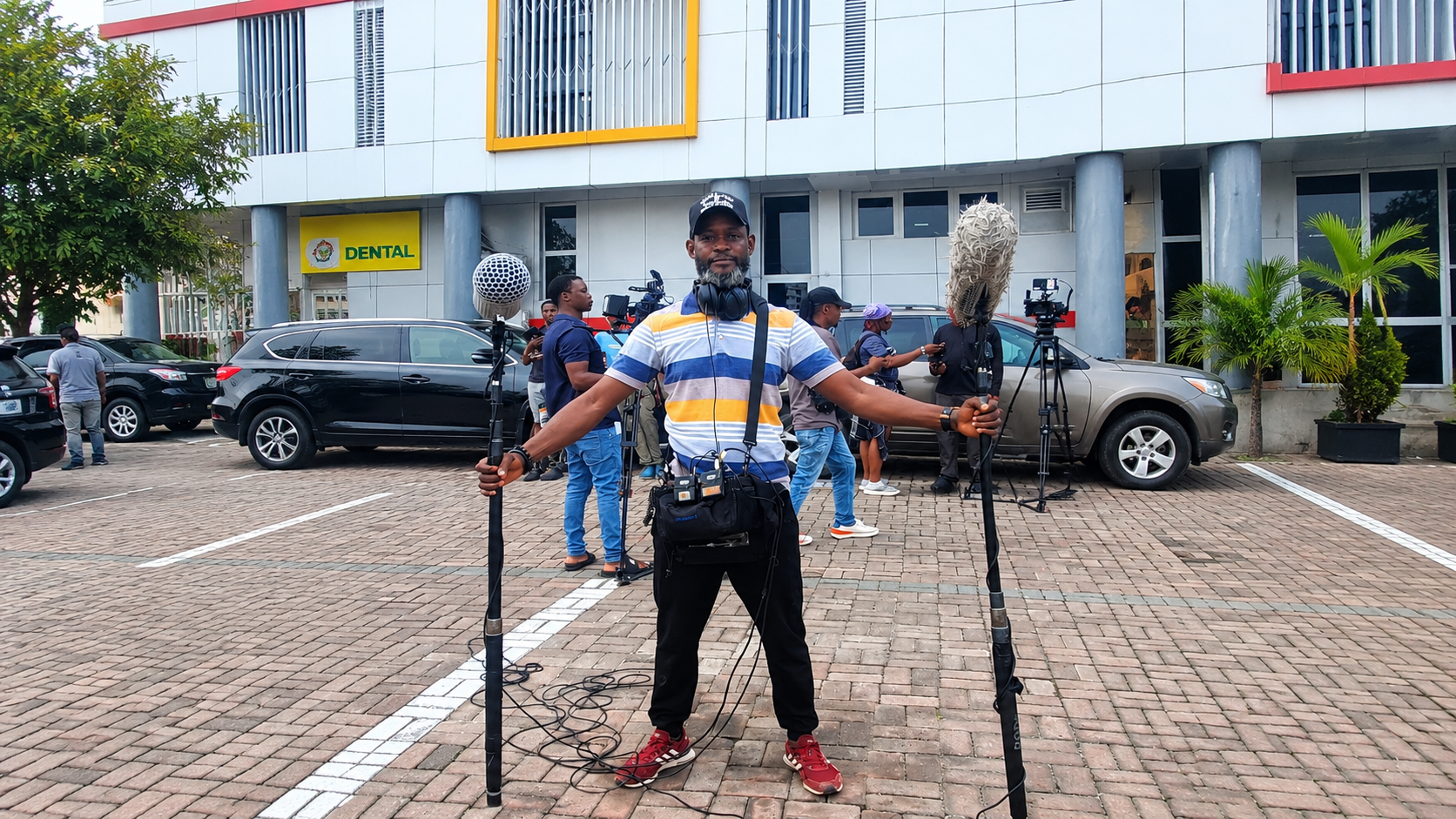
In short
Olamilekan Lasisi Murphy is a Lagos-based location sound recordist who says Nigerian film sets routinely undervalue the sound department, a mistake that has led to finished films being rejected by streaming platforms over audio quality.
- Desk:
- film
- Format:
- interview
- Author:
- Kenneth Onyebuchi
On a Nigerian film set, the director gets the credit, the cinematographer gets the praise, and the sound man gets a pair of headphones and a mixer nobody else on set fully understands. Olamilekan Lasisi Murphy, a Lagos-based location sound recordist who has worked across Nollywood productions for close to two decades, has spent that entire career inside that gap. He has pulled clean, broadcast-ready dialogue out of a scene recorded beside a generator nobody could switch off. He has watched a finished film get rejected by a streaming platform because of audio nobody fixed in post-production. And he still cannot name a single sound recordist in Nigeria, including the country's most prominent one, who owns a complete professional kit. Murphy spoke to PINCHED about how he found his way into sound, what a bad day on set actually costs a production, and why he believes directors need to start listening to the person wearing the headphones.
How Murphy Found Sound
Murphy did not set out to become a sound recordist. After losing a job in the early 2000s, he ran into an old schoolmate, a theatre arts student, while submitting his CV to a production company. She was pitching a film she wanted to shoot and invited him onto the crew. He assumed the role would be a general production assistant job, the kind that trails after whoever is in charge. It was only once he arrived on set that he realised he had walked into the film industry instead.
That first job connected him to Emmanuel Solomon, a respected Nigerian sound engineer based out of Abuja and Kaduna rather than Lagos, who had cut his teeth working with the BBC. Murphy had originally hoped to get into camera work, but the person meant to train him on camera never showed up. On that BBC-adjacent set, a crew member noticed Murphy's height and suggested he try sound instead, since boom operation rewards someone who can hold a microphone steady above a scene for long stretches. Murphy started at the bottom, bashing cables, with no idea which button on the gear in front of him did what. "Ever since then, that was how I came into sound," he said. He is not the only one to arrive in sound by a roundabout route. PINCHED also spoke to Habib, who went from carrying cameras to capturing sound.
The Generator Nobody Could Switch Off
The story that first caught PINCHED's attention was a shoot where the only available location that matched the story had a large, loud generator running beside it, with no way to move production elsewhere. Both the producer and the executive producer came directly to Murphy to ask if the location could still work.
"I told them, no problem, I'll try my best in this location, I'll apply my techniques," he said. He would not promise a perfect result in advance, only his best effort with the settings on his mixer. By the time the recording reached post-production, editors told him the generator noise had been removed so cleanly that no actor needed to be called back for ADR, the process of re-recording dialogue in a studio when the original audio cannot be salvaged. The production's AP sent him a gift as thanks.
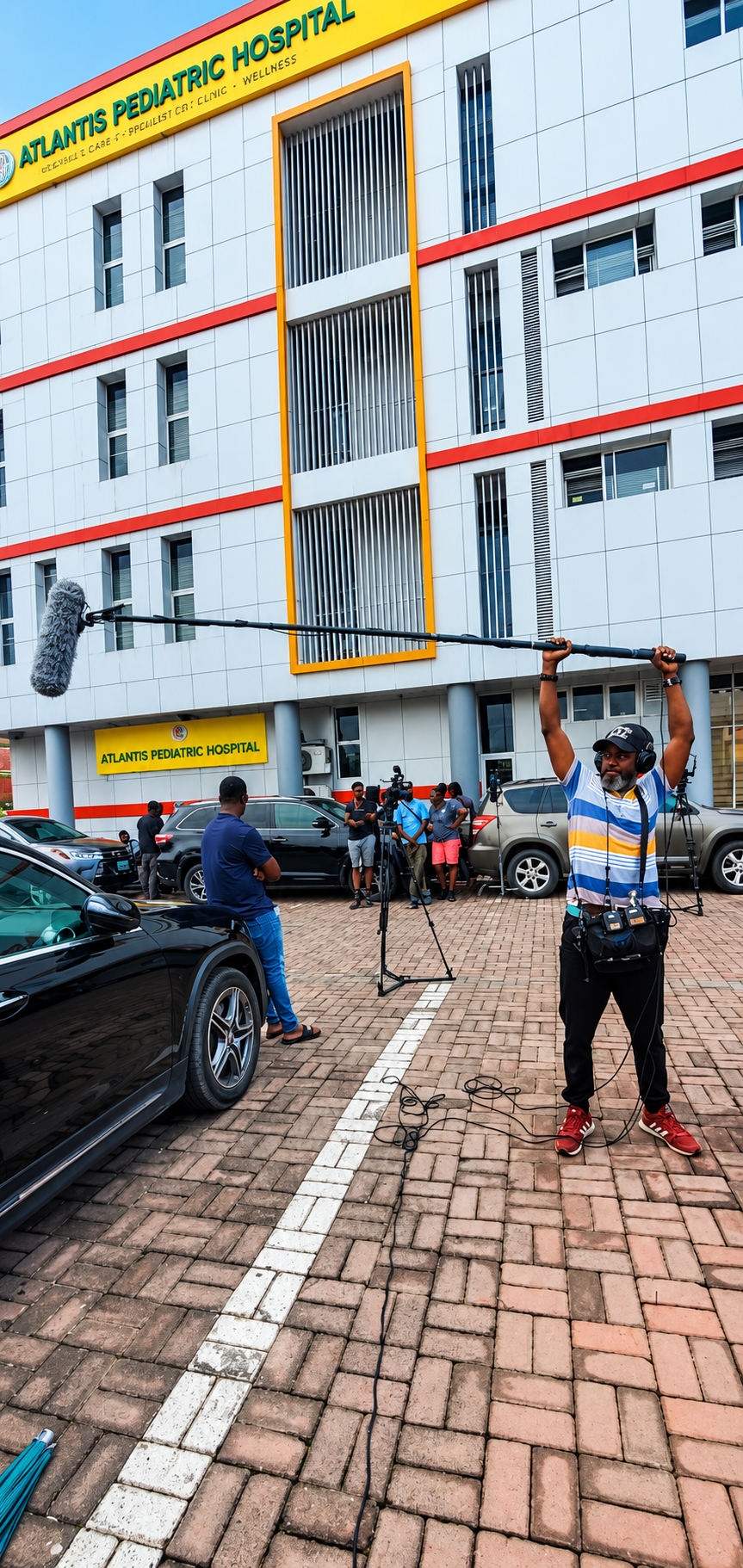
Olamilekan Lasisi Murphy at work
The Job Nobody Claps For
Murphy argues that sound carries roughly half of what makes a film work, yet remains the department least understood by the people paying for it. He described being hired for a project where he quoted a fair price based on the script and the equipment it required, and the producer refused, calling the quote too high. Murphy turned the job down rather than deliver what he called "a shabby job" with underpowered gear. A year later, the same person called him again for a different project. Mid-conversation, Murphy learned it was the earlier film, shot with someone else at a lower price. A streaming platform had rejected the finished film outright because of its audio, forcing a full reshoot that cost far more than Murphy's original quote would have.
He points to dedicated sound awards only recently appearing at ceremonies like the AMVCAs as evidence of how late the recognition has come, and to Netflix's own production standards, which specify the exact equipment and mixer settings a Nigerian crew must use, as proof that the gap is noticed outside the country even when it isn't inside it. Unlike lighting, which sits under the cinematographer's direction, sound answers to no one else on set. "You are a department of your own," Murphy said. "Every dialogue, every ambience that comes in, it's only you that knows what you're hearing."
When the Editor Used the Wrong Track
Murphy described a project where he handed off two kinds of audio after a shoot: a rough reference track mixing every microphone together for a quick first edit, and the clean, isolated multi-track recording meant to replace it before the film was finished. An editor used the reference track straight through to the final cut. When the film was prepared for a platform using a cinema sound standard Nigerian productions rarely use, the noise buried in that reference track became impossible to miss, and the film was rejected.
The producer called Murphy directly to say the sound recording was the problem. He went to the editing office himself, asked for the original mixer recording, and played it back untouched. It was clean. The lead editor who had instructed the junior editors to use the reference track had not been in the room to explain why. "It goes beyond just recording and leaving," Murphy said of the experience. "My name goes with it. I like protecting my name."
What's Actually in the Bag
Murphy is blunt about the economics of his craft. A complete professional sound kit in Nigeria, he estimates, would cost close to 30 million naira once every piece is accounted for, and he says he does not know a single sound recordist in the country, including its most recognised name, who owns one outright. Most productions work with a Zoom F8 or F4 recorder. Higher-budget shoots step up to Sound Devices equipment, among them the MixPre-10 and the 833 and 888 mixers.
His own technique leans on restraint rather than firepower. He records at low gain rather than high, reasoning that a quieter original recording gives an editor room to raise it cleanly, while a hot recording carries every bit of Lagos's ambient noise along with it once it's brought back down. He is equally deliberate about microphone placement on an actor's body, working to avoid the rustle of clothing against a hidden mic before it ever becomes a problem to fix later.
The Lesson From Soulja Story
A 2015 production called Soulja Story taught Murphy the lesson he now treats as non-negotiable. He was told the film had no budget and should work with whatever basic gear was available. When he arrived on set, the production was shooting on a RED camera, equipment that costs considerably more than professional sound gear. The producer supplied microphones that performed poorly, refused to let Murphy source his own, and dismissed his concerns when he raised them. Murphy worked around the limitations and finished the project, which went on to win an award. When the same producer wanted to shoot a sequel, he called someone else instead.
"That changed my perception," Murphy said. "No matter how you are, even if you are my friend, if you are calling me for a movie, you have to be professional. The equipment has to be professional. I don't want to know whether it's a small budget or a low budget."
A Short Film About What Sound People Hear
Murphy has an unproduced script built around what he sees as the sound department's unique position on a film set: present for everything, trusted by nobody to repeat what they heard. The concept follows two actors rehearsing a scene, with one turning threatening toward the other once the cameras are rolling and the only other person present is the sound recordist, whose microphone keeps recording throughout. Murphy wrote it to dramatize how much a sound person witnesses that never leaves the set. He budgeted around 500,000 naira to shoot it with recognisable actors, but that fell short of what he needed, and the project remains on paper. He says a platform like PINCHED is the kind of place he could eventually use to share the idea alongside gear breakdowns and on-set footage with other filmmakers.
What He Wants Directors to Understand
Asked what he wants directors, producers and audiences to take from the conversation, Murphy did not hesitate. "They should always listen to their sound man," he said. He contrasted how crews respond when a cinematographer says a shot won't work, which is to look for an alternative immediately, with how they respond when the sound recordist raises the same kind of objection, which is often to push back and ask him to make it work anyway. He understands the pressure productions are under to stay within a fixed number of shooting days, with hotels, feeding and cast fees all riding on it. But when something goes wrong with the audio and nobody listened to the warning, he said, the blame still lands on the sound man. "Why didn't he insist," he said. "He needs his job." For Murphy, that is the whole point. His name is on every job he takes, and protecting it means his job and his career come first, before anything else.
Frequently Asked Questions
Who Is Olamilekan Lasisi Murphy?
He is a Lagos-based location sound recordist who has worked on Nigerian film and television productions for close to two decades, handling production sound on set for dialogue, ambience and multi-track recording.
Why Does Location Sound Matter on a Film Set?
Clean location sound reduces or removes the need for ADR, where actors re-record dialogue in a studio after filming. Poor on-set sound has led to finished Nigerian films being rejected by streaming platforms and sent back for costly reshoots.
What Equipment Do Nigerian Sound Recordists Typically Use?
Most productions work with Zoom F8 or F4 recorders. Higher-budget shoots use Sound Devices equipment such as the MixPre-10 or the 833 and 888 mixers. A complete professional kit can cost close to 30 million naira.
- Location Sound
- Nollywood
- Film Production
- Sound Design
- Crew Stories
Tip: highlight any line in the story to turn that line into a share card.
Frequently asked
- What is “"They Don't Give Us Enough Accolades": Location Sound Recordist Olamilekan Lasisi Murphy” about?
- Murphy has recorded sound next to a generator nobody could switch off, watched a finished film get rejected by a streaming platform over bad audio, and still can't tell you a single colleague who owns a complete… Murphy has recorded sound next to a generator nobody could switch off, watched a…
- Who covers film on PINCHED?
- Kenneth Onyebuchi reports this piece for the PINCHED film desk.
- Where can I read “"They Don't Give Us Enough Accolades": Location Sound Recordist Olamilekan Lasisi Murphy”?
- Read it in full at https://staypinched.site/read/olamilekan-lasisi-murphy-location-sound-interview.