How to Protect Your Future Children From Sickle Cell: What Every Nigerian Should Know This Awareness Month
Nigeria carries the world's heaviest sickle cell burden. Here's what your genotype actually means, and what to do about it, before it's too late to matter.
Choose your narrator
In short
Sickle Cell Awareness Month is observed every September, and it matters especially for Nigerians, since Nigeria carries the world's heaviest sickle cell burden, with an estimated 40 million carriers and around 150,000 babies born with the disease annually.
- Desk:
- on the sport
- Format:
- article
- Author:
- Praise_writes
You've probably heard someone ask, "what's your genotype?" at some point, maybe on a first date, maybe from a worried parent. However, you may not fully understand why that one question carries so much weight in Nigeria specifically. Sickle Cell Awareness Month is exactly the moment to actually understand it, not just repeat it.
This isn't meant to scare you. It's meant to hand you the information in one place, clearly, so you can make decisions for your own life and family with actual facts instead of half-remembered warnings from aunties and biology class.
What Is Sickle Cell Disease, in Plain Terms?
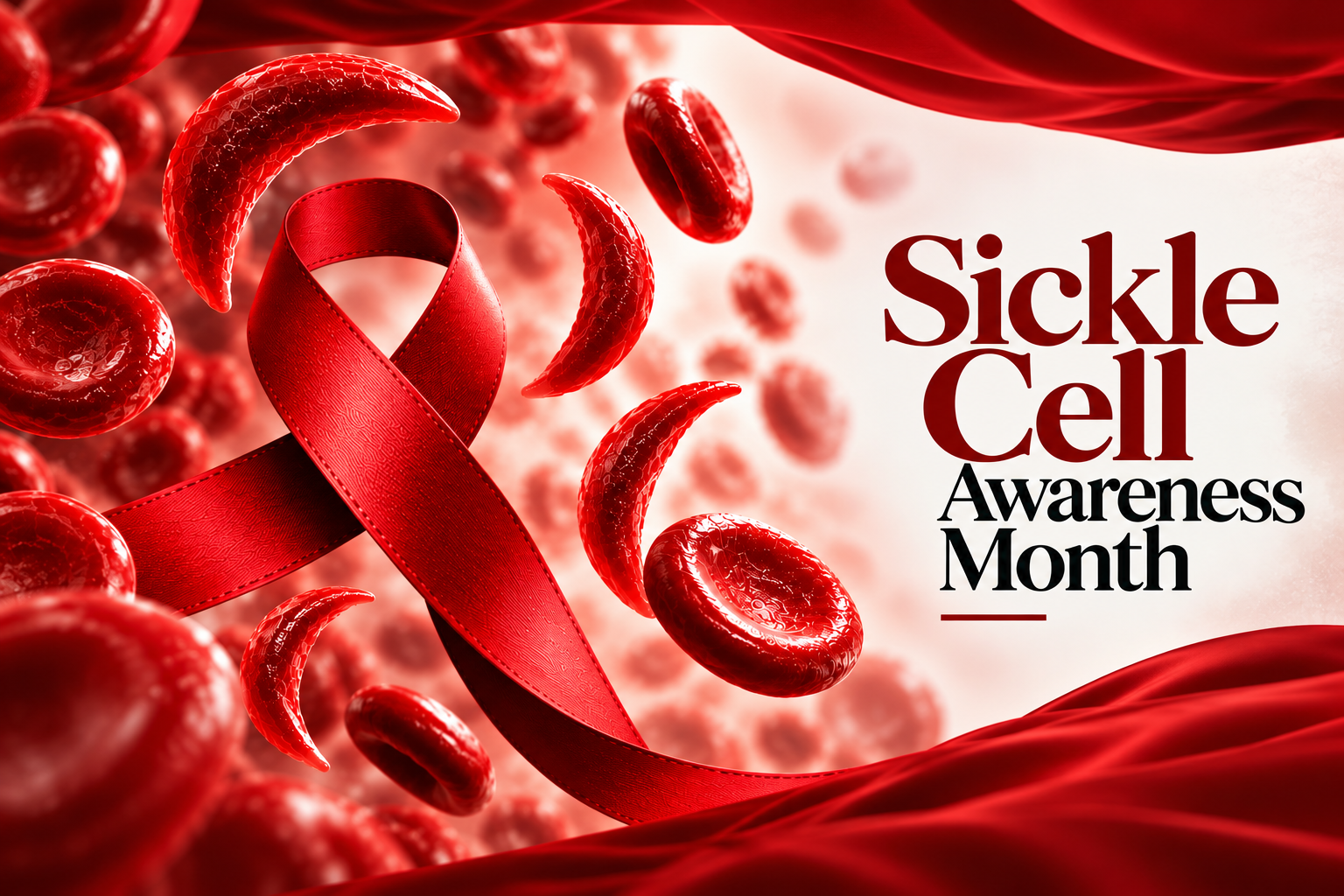
Sickle cell disease is a genetic blood disorder you inherit from your parents, not something you catch or develop later in life. It changes the shape of your red blood cells from smooth, flexible discs into rigid, crescent, or "sickle," shapes.
Those misshapen cells don't move through your blood vessels easily. They get stuck, block blood flow, and cause what's known as a sickle cell crisis, episodes of severe pain, alongside a higher risk of infections, stroke, and organ damage over time.

Sickle cell awareness month. Source @scago_queens on I.G
When Is Sickle Cell Awareness Month, and Why Should You Care?
September is recognised as National Sickle Cell Awareness Month, a designation Congress made back in 1983, Nigeria also observes its own dedicated date, World Sickle Cell Day, every June 19, with 2026's theme being "Closing the Survival Gap: Equity in Sickle Cell Disease.”
Here's the part that should make this personal rather than just informational, you don't need a family history of sickle cell disease for it to affect you. You could be a carrier and never know it, until you're planning a family with someone who is too.
The Numbers That Should Stop You Mid-Scroll
Nigeria isn't just affected by sickle cell disease, it also carries the world's heaviest sickle cell burden. An estimated 40 million Nigerians carry the sickle cell gene, and around 150,000 babies are born with sickle cell anaemia in Nigeria every single year, roughly half of all new severe cases worldwide.
A consultant haematologist with the Kebbi Sickle Cell Association put similar figures directly, telling The Gazette that over 138,000 children are born with the disease annually, and that roughly 25% of the population carries the trait. He called it "the most potent killer for under five children."
That's not a statistic to scroll past. That's a number that touches nearly one in four families you know.
How Genotype Actually Works: AA, AS, and SS Explained
This is the part school often glosses over, so here it is plainly. Your genotype describes which version of the haemoglobin gene you inherited from each parent:
AA — no sickle cell gene, the most common genotype
AS — a carrier ("sickle cell trait"), usually healthy, but capable of passing the gene on
SS — sickle cell disease itself, both genes inherited are the sickle version
Here's why the combination of two people's genotypes matters so much:
AA + AA or AA + AS: no risk of a child with sickle cell disease
AS + AS: a 25% chance, with every single pregnancy, of a child with SS (sickle cell disease)
AS + SS or SS + SS: a significantly higher risk, up to 50% or more, of a child affected
As Akwa Ibom's National Orientation Agency director put it directly, high-risk pairings like these are "avoidable tragedies." His words, not softened for effect.
How to Know Your Genotype
If you've never actually confirmed your genotype, here's exactly how to close that gap:
Visit any general hospital or accredited medical laboratory, genotype testing is a simple, affordable blood test, not a specialist procedure
Ask specifically for a haemoglobin electrophoresis test, this is what confirms AA, AS, SS, or rarer variants accurately
Get tested before you're seriously considering marriage, not after, so the conversation happens while it can still shape a decision
Have your partner tested too, your genotype alone tells you nothing about your combined risk
Common Myths That Keep Costing Lives
Part of why this disease keeps spreading at the rate it does in Nigeria comes down to persistent myths, ones worth clearing up directly:
"If I feel healthy, I can't be a carrier." False. AS carriers usually show no symptoms at all, which is exactly why so many people find out only after having an affected child.
"Sickle cell only matters if it runs in your family." False. The trait can appear even without a known family history, since it's been circulating quietly across generations.
"Love should be enough to make a relationship work, genotype shouldn't matter." This is where emotion and biology clash hardest, however genotype compatibility isn't about love, it's about the odds your future children will face, an entirely separate conversation from whether two people are right for each other.
"Getting tested means you don't trust your partner." False. It means you're both taking a shared decision seriously, which is its own form of care.
"It's Not a Death Sentence": Living With Sickle Cell Today
Here's something worth holding onto, if you or someone you love has SS genotype, this is genuinely not the death sentence it was once treated as. Timi Edwin, founder of the CrimsonBow Sickle Cell Initiative, made this point directly at a Lagos awareness event: sickle cell disorder "was not a death sentence," she said, while still calling for wider public awareness and support.
Management has genuinely improved, pain management, infection prevention, folic acid supplementation, and in some cases hydroxyurea therapy all help reduce crises and improve quality of life. Bone marrow transplant remains the only established cure, though it's a high-risk procedure typically reserved for specific cases, not a first-line option.
What's changed most isn't the biology, it's the visibility. More people living with SS genotype are speaking publicly about their lives, careers, and families today than a generation ago, which matters enormously for anyone newly diagnosed who assumes the worst is automatically ahead of them.
What You Can Actually Do This Month
Get your genotype checked if you genuinely don't know it, this single test changes everything downstream
Have the genotype conversation early in any serious relationship, not after the wedding is already planned
Support local advocacy groups like the Sickle Cell Advocacy and Management Initiative, many run free testing and clinics
Donate blood if you're able, sickle cell patients frequently need transfusions, and Nigeria's blood supply consistently runs short
Talk about it openly, stigma keeps too many people from getting tested at all, silence has never protected anyone
You don't need to wait for a scare, a diagnosis, or a wedding date to find out your genotype. This month is as good a reason as any to just go find out, and to make sure whoever you build a future with knows theirs too.
Frequently Asked Questions
1. Can two AS parents have a completely healthy child?
Yes. Two AS parents have a 25% chance per pregnancy of an SS child, but also a 50% chance of an AS child and a 25% chance of an AA child, every pregnancy carries independent odds.
2. Is sickle cell disease curable?
Bone marrow transplant is currently the only established cure, though it carries significant risk and isn't available or suitable for everyone. Most people manage the condition through ongoing care rather than a cure.
3. Why is sickle cell so common in Nigeria specifically?
The sickle cell gene is believed to have persisted because carriers (AS) have some natural resistance to malaria, an evolutionary trade-off that became widespread across malaria-endemic regions, including West Africa.
4. Where can I get a genotype test in Nigeria?
Most general hospitals, teaching hospitals, and accredited private laboratories offer haemoglobin electrophoresis testing, typically at an affordable, walk-in cost.
5. Does having sickle cell trait (AS) cause any symptoms?
Generally no. AS carriers typically live entirely normal, healthy lives, which is precisely why testing, rather than waiting for symptoms, is the only reliable way to know your status.
- Sickle Cell Awareness Month
- Genotype Test Nigeria
- Sickle Cell Disease Nigeria
- AS Genotype
- Sickle Cell Prevention
Tip: highlight any line in the story to turn that line into a share card.
Frequently asked
- What is “How to Protect Your Future Children From Sickle Cell: What Every Nigerian Should Know This Awareness Month” about?
- You've probably heard someone ask, "what's your genotype?" at some point, maybe on a first date, maybe from a worried parent. However, you may not fully understand why that one question carries so much weight in… Nigeria carries the world's heaviest sickle cell burden.
- Who covers on the sport on PINCHED?
- Praise_writes reports this piece for the PINCHED on the sport desk.
- Where can I read “How to Protect Your Future Children From Sickle Cell: What Every Nigerian Should Know This Awareness Month”?
- Read it in full at https://staypinched.site/read/you-ve-probably-heard-someone-ask-what-s-your-genotype-at-some-point-maybe-on-a.