The Dangote Refinery IPO Overloaded Nigeria's Investment Apps, and Fintechs Are Charging ₦0 Anyway
Bamboo's traffic rose tenfold within 30 minutes of Africa's biggest share sale opening, and rival platforms struggled too. Fintechs are still waiving fees, because the customers they win now may be worth more than any commission.
Choose your narrator

In short
The Dangote refinery IPO is a ₦2.15 trillion share offer that runs from 14th September to 13th October 2026, priced at ₦525 per share with a ₦5,250 minimum. Traffic overwhelmed apps such as Bamboo on day one, and fintechs are waiving direct fees to win first-time investors.
- Desk:
- tech
- Format:
- article
- Author:
- Kenneth Onyebuchi
When the Dangote refinery IPO opened on 14th September, several of Nigeria's biggest retail investing apps buckled under the crowd. Bamboo's traffic reached ten times its normal level within 30 minutes, and users of Cowrywise and InvestNaija reported trouble as well. Yet the same fintechs are charging investors nothing to buy the shares, a choice that makes more sense once you know how an IPO works and who gets paid when one sells.
What an IPO Is and Why Companies Run One
An initial public offering, or IPO, is the first time a company sells its shares to the public, as the US Securities and Exchange Commission's investor education site describes it. Until then, a business belongs to its founders and a few private backers. Afterwards, anyone with a brokerage account or a participating app can buy a slice, and the company raises money for expansion or debt repayment in return for regular financial reporting and investor scrutiny.
That is the deal Aliko Dangote put to the public when the Dangote refinery IPO opened on 14th September 2026. Bamboo's investor guide describes it as an offer for subscription, which means the refinery is creating new shares and keeps the proceeds itself, with no existing shareholder cashing out.
How the Dangote Refinery IPO Works
The offer closes on 13th October. It covers 4.1 billion shares at a fixed ₦525 each, which would raise ₦2.15 trillion, about $1.6 billion, if fully subscribed, according to Nairametrics. The minimum application is 10 shares, or ₦5,250, with allotment indicatively expected around November and a listing on the Nigerian Exchange after the SEC clears the basis of allotment.
Dangote has called it the biggest IPO in African history, and France 24 reported that he wants up to 10 million shareholders, including drivers and domestic workers. Nigeria has about 2.7 million retail investors today, TechCabal reports, so that target is close to four times the existing base. Reaching them depends on distribution, and Nairametrics says the offer runs through banks, fintech platforms, mobile operators and NGX Invest, and Chuka Eseka, chief executive of Vetiva Capital Management, called it the first Nigerian public offer that retail investors can subscribe to entirely through digital channels. That reach shows up off the apps too, in the wave of jokes about newfound shareholder status that PINCHED tracked in this piece.
What Happened to the Apps on Day One
Bamboo, which accounted for about 22 per cent of equity transactions on the Nigerian Exchange in the seven months to July, according to Nairametrics, was among the first to buckle. Within minutes of the opening it told users on X that traffic was far higher than expected, and Cowrywise reported more traffic than usual, France 24 reported. Yanmo Omorogbe, Bamboo's co-founder and chief operating officer, told Reuters that traffic reached ten times normal levels within 30 minutes, that some of Bamboo's third-party providers were hit as well, and that repeated retries from customers piled more load onto the system.
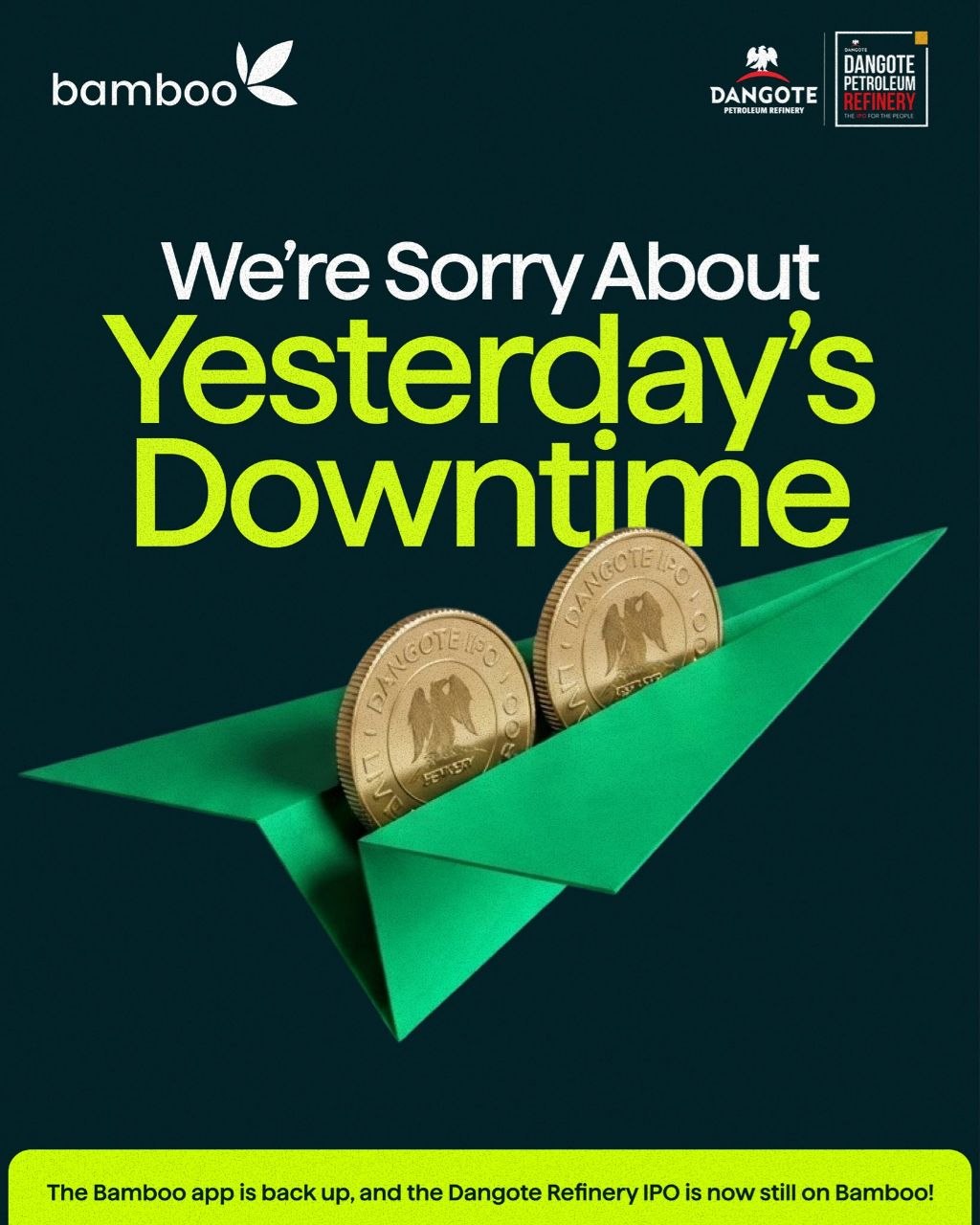
Bamboo's public apology to users on 15th September 2026. Source: @investbamboo on X
Bamboo had spent two to three months preparing and had opened more than 236,000 new accounts in the week before the offer, Nairametrics reports. Users of Cowrywise and InvestNaija also reported trouble accessing services, according to Reuters, and NGX Group chief executive Temi Popoola said demand was high enough that some investment apps crashed. Reuters noted that neither Dangote nor the underwriters had published demand figures, and that the disruptions pointed to strong retail interest.
Why Banks Held Up While Fintech Apps Buckled
Lotus Bank offers a contrast, according to Technext, which reported that the bank treated the IPO as a high-volume retail event well before day one and ran simulations of the expected traffic. It let customers subscribe through its mobile app, its internet banking or a branch, with all three routes feeding one subscription process. When one route slowed, teams watching channel performance live moved customers to another. Akin Adegoke, the bank's divisional head of growth and digital transformation, told Technext the bank measures resilience by how quickly it detects a problem, responds and recovers while customers keep access.
Technext's reading is that a pure app platform has one point of entry, so a jam there leaves users with nowhere else to go. The account comes from Lotus Bank and a single publication, and no independent uptime data for banks has been released, so it works better as a design lesson than as a ranking.
Why Fintechs Are Charging ₦0
TechCabal reported that Bamboo, Cowrywise and PiggyVest are charging users no direct transaction fees on the offer, waiving items such as brokerage, stamp duty and trade alerts, because winning the customer is the bigger prize. Bamboo's guide confirms zero commissions on its platform.
The platforms still expect to be paid, and Sycamore, another approved distribution channel, told Nairametrics that investors pay it nothing while it is eligible for a placement distribution fee on the issue. Fees on offers like this typically run from 0.5 to 1 per cent of subscription value, Sycamore said, which would imply ₦10.75 billion to ₦21.5 billion across all channels if applied to the full offer. Nairametrics stressed that this is a hypothetical industry-wide figure and says nothing about what any single platform will earn.
The larger bet is retention, and Sycamore called the IPO "one of the strongest retail investor acquisition events a fintech can get". For the apps that went down on day one, the coming weeks also show whether their new customers trust them enough to stay.
Lessons From Nairobi and Nasdaq
Retail-heavy offers on this scale have been tried before, and Kenya's 2008 Safaricom sale, in which the government sold a 25 per cent stake, drew about 820,000 local retail buyers, Euromoney reports. Capital FM found both the local and international pools oversubscribed by 453 per cent. Euromoney adds that the share price fell within days as the global financial crisis unfolded, eventually reaching about 40 per cent of the offer price, while Daba Finance notes that holders who stayed put over the following decade were rewarded.
The technology side has a precedent too: when Facebook listed on Nasdaq on 18th May 2012, a design limitation in the exchange's order-matching system disrupted the offering, and Nasdaq paid a $10 million SEC fine, NBC News reported. Nasdaq said it had tested its systems beforehand and the flaw still went undetected until the day itself. Bamboo, likewise, had prepared for months, and in both cases the preparation missed a limit that live demand found.
What to Watch Before 13 October
Reuters reported that regulators and market participants urged first-time investors to be cautious. Analysts have raised ownership and price points as well. Joachim McEbong of Control Risks told France 24 that calling the offer people-driven is hard to square with Dangote keeping 87 per cent of the refinery, and Lagos-based investor Abdulkabeer Tijani said the price may already be expensive, while TechCabal puts the value the offer implies at about ₦63 trillion, or $47.6 billion.
On the technology side, the useful signals will be whether Bamboo, Cowrywise and InvestNaija publish what went wrong, and whether allotment data later shows which channels carried the most subscriptions. Elsewhere in Nigerian tech policy this month, President Tinubu ordered a 180-day roadmap for the country's Digital Free Zones, which PINCHED covered as a push to keep founders incorporating at home.
This article explains how the offer works and is not investment advice.
Frequently Asked Questions
What Is an IPO?
An initial public offering is the first sale of a company's shares to the public. It lets a private company raise money from many investors and become publicly listed, in return for regular financial reporting.
When Does the Dangote Refinery IPO Close?
The offer opened on 14th September 2026 and closes on 13th October 2026, with allotment indicatively expected around November.
What Is the Minimum Investment in the Dangote IPO?
The minimum application is 10 shares at ₦525 each, which is ₦5,250. Additional shares are bought in multiples of 10.
Why Did Bamboo and Cowrywise Crash on Day One?
Bamboo said its traffic rose to ten times normal levels within 30 minutes, some third-party providers were also affected, and repeated retries added load. Cowrywise reported more traffic than usual.
Are Fintech Apps Charging Fees for the Dangote IPO?
TechCabal reported that Bamboo, Cowrywise and PiggyVest charge no direct transaction fees. Sycamore told Nairametrics that investors pay nothing through its platform, and Anchoria Capital's Kehinde Jones said the subscription itself is exempt from VAT. Check each platform's terms before subscribing.
- Dangote Refinery IPO
- Nigerian fintech
- Bamboo
- Cowrywise
- IPO explained
- Nigerian Exchange
- retail investing
- fintech infrastructure
Tip: highlight any line in the story to turn that line into a share card.
Frequently asked
- What is “The Dangote Refinery IPO Overloaded Nigeria's Investment Apps, and Fintechs Are Charging ₦0 Anyway” about?
- Bamboo's traffic rose tenfold within 30 minutes of Africa's biggest share sale opening, and rival platforms struggled too. Fintechs are still waiving fees, because the customers they win now may be worth more than any… Bamboo's traffic rose tenfold within 30 minutes of Africa's biggest share sale…
- Who covers tech on PINCHED?
- Kenneth Onyebuchi reports this piece for the PINCHED tech desk.
- Where can I read “The Dangote Refinery IPO Overloaded Nigeria's Investment Apps, and Fintechs Are Charging ₦0 Anyway”?
- Read it in full at https://staypinched.site/read/dangote-refinery-ipo-fintech-apps-crash-zero-fees.